
Pencil (1 × 10⁻² m)
Virus (1 × 10⁻⁶ m)
Red Blood Cell (1 × 10⁻⁴ m)
Dust Particle (1 × 10⁻⁷ m)
Now you could imagine how small an
atom would be.
An atom is thousand times smaller than
the thickest human hair. It has an average
diameter of 0.000000001 m or 1 × 10⁻⁹ m. To
understand the size of an atom, now let us find
what is the size of known things like pencil, red
blood cell, virus and dust particle.
Many scientists have studied the structure
of the atom and advanced their theories about
it. The theories proposed by Dalton, Thomson
and Rutherford are given below.
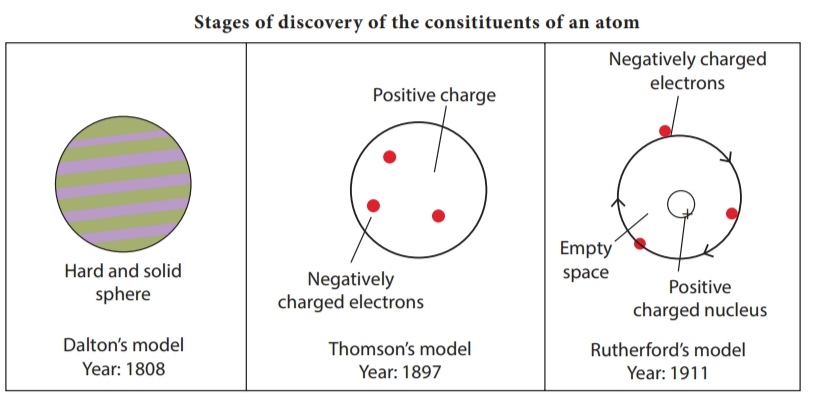
Dalton’s atomic theory :
John Dalton
proposed an atomic
theory in the year
1808. He proposed that
matter consists of very
small particles which
he named atoms. An
atom is the smallest indivisible particle. It
is spherical in shape. His theory does not
propose anything about the positive and
negative charges of an atom. Hence, it was
not able to explain many of the properties of
substances.
Nanometer is the smallest
unit used to measure small
lengths. One nanometer
is equal to 1 × 10⁻⁹ m.
Thomson’s theory :
In 1897 J.J Thomoson
proposed a different
theory. He compared an
atom to a watermelon.
His theory proposed that
an atom has positively
charged part like the red
part of the watermelon and in it are embedded,
like the seeds, negatively charged particles
John Dalton
J.J. Thomsonwhich he called electrons. According to this
theory as the positive and negative charges
are equal, the atom as a whole does not have
any resultant charge.
Thomson’s greatest contribution was
to prove the existence of the negatively
charged particles or electrons in an atom by
experimentation. For this discovery, he was
awarded the Nobel Prize in 1906. Although
this theory explained why an atom is neutral,
it was an incomplete theory in other ways
Rutherford’s theory
There were
shortcoming in
Thomson’s theory.
Earnest Rutherford
gave a better
understanding. Earnest
Rutherford conducted
an experiment. He
bombarded a very thin layer of gold with
positively charged alpha rays. He found that most
of these rays which travel at a great velocity passed
through thin gold sheet without encountering any
obstacles. A few are, however, turned back fromthe sheet. Rutherford considered this remarkable
and miraculous as if a bullet had turned back
after colliding with tissue paper. Based on this
experiment, Rutherford proposed his famous
theory. They are:
1. The fact that most alpha particles pass
through the gold sheet means that the atom
consists mainly of empty space.
2. The part from which the positively charged
particles turned back is positively charged
but it is very small in size as compared to
the empty space.
From these inferences, Rutherford
presented his theory of the structure of atoms.
For this theory, he was awarded the Nobel prize
for chemistry.
Rutherford’s theory proposes the following.
1. The nucleus at the centre of the atom has
positive charge. Most of the mass of the
atom is concentrated in the nucleus.
2. The negatively charged electrons revolve
around the nucleus in specific orbits.
3. In comparison with the size of the atom, the
nucleus is very very small.
 rakupmaedcation. com