Electric field due to any arbitrary charge
configuration can be calculated using
Coulomb’s law or Gauss law. If the charge
configuration possesses some kind of
symmetry, then Gauss law is a very efficient
way to calculate the electric field. It is
illustrated in the following cases.
Cases
(i) Electric field due to an infinitely long
charged wire
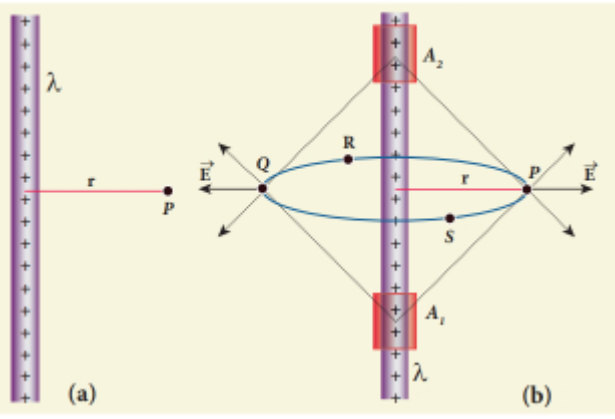
Consider an infinitely long straight
wire having uniform linear charge density
λ(charge per unit length). Let P be a point
located at a perpendicular distance r from
the wire . The electric field
at the point P can be found using Gauss law.
We choose two small charge elements
A1
and A2
on the wire which are at equal
distances from the point P. The resultant
electric field due to these two charge
elements points radially away from the
charged wire and the magnitude of electric
field is same at all points on the circle
of radius r. This is shown in the FigureSince the charged wire possesses
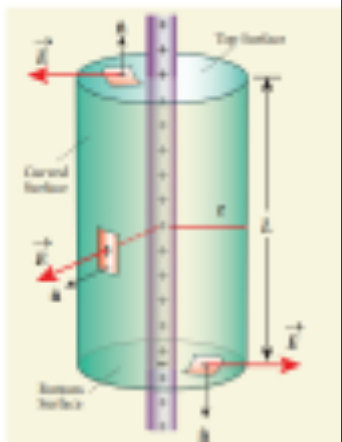
a cylindrical symmetry, let us choose a
cylindrical Gaussian surface of radius r and
length L as shown .
The total electric flux through this closed
surface is calculated as follows
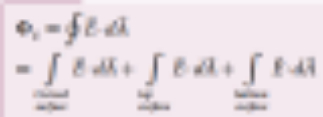
applying Gauss law to the
cylinderical surface

Since the magnitude of the electric field
for the entire curved surface is constant, E istaken out of the integration and Qencl is given
by Q L encl = λ , where λ is the linear charge
density (charge present per unit length).

Here dA
Curved surface
∫ = total area of the curved
surface = 2πrL. Substituting this in equation
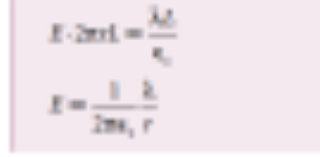
In vector form,

The electric field due to the infinite
charged wire depends on 1/
r
rather than 1 /
r2
.
The equation is true only for an
infinitely long charged wire. For a charged
wire of finite length, the electric field
need not be radial at all points. However,
equation for such a wire is taken
approximately true around the mid-point
of the wire and far away from the both ends
of the wire
(ii) Electric field due to charged infinite
plane sheet
Consider an infinite plane sheet of
charges with uniform surface charge
density σ (charge present per unit area).
Let P be a point at a distance of r from the
sheet as shown in the.
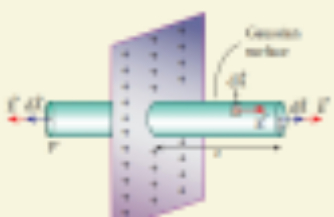
Since the plane is infinitely large, the
electric field should be same at all points
equidistant from the plane and radially
directed outward at all points. A cylindrical
Gaussian surface of length 2r and two flats
surfaces each of area A is chosen such that the
infinite plane sheet passes perpendicularly
through the middle part of the Gaussian
surface.
Total electric flux linked with the
cylindrical surface,
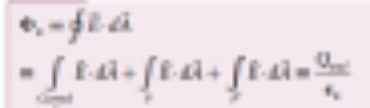
The electric field is perpendicular to
the area element at all points on the curved
surface and is parallel to the surface areas
at P and P′ . Then, applying
Gauss’ law,

Since the magnitude of the electric field
at these two equal flat surfaces is uniform,
E is taken out of the integration and Qencl is
given by Q A encl = σ , we get

The total area of surface either at P or P
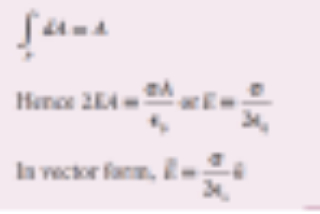
Here n
is the outward unit vector
normal to the plane. Note that the electric
field due to an infinite plane sheet of charge
depends on the surface charge density and is
independent of the distance r.
The electric field will be the same at any
point farther away from the charged plane.
Equation implies that if σ > 0 the
electric field at any point P is along outward
perpendicular n drawn to the plane and
if σ < 0, the electric field points inward
perpendicularly to the plane (-n ).
For a finite charged plane sheet, equation
is approximately true only in the
middle region of the plane and at points far
away from both ends.
(iii) Electric field due to two parallel
charged infinite sheets
Consider two infinitely large charged
plane sheets with equal and opposite charg e
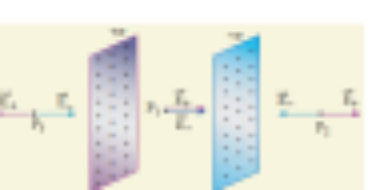

densities +σ and -σ which are placed parallel
to each other as shown in the .
The electric field between the plates and
outside the plates is found using Gauss law.
The magnitude of the electric field due to
an infinite charged plane sheet is σ
2e
and it
points perpendicularly outward if σ > 0 and
points inward if σ < 0.
At the points P2
and P3
, the electric field
due to both plates are equal in magnitude
and opposite in direction . As
a result, electric field at a point outside the
plates is zero. But between the plates, electric
fields are in the same direction i.e., towards
the right and the total electric field at a point
P1
isThe direction of the electric field between
the plates is directed from positively charged
plate to negatively charged plate and is
uniform everywhere between the plates.
(iv) Electric field due to a uniformly
charged spherical shell
Consider a uniformly charged spherical
shell of radius R carrying total charge Q as
shown in Figure 1.40. The electric field at
points outside and inside the sphere can be
found using Gauss law.
Case (a) At a point outside the shell (r > R)
Let us choose a point P outside the shell
at a distance r from the centre as shown in
(a). The charge is uniformly
distributed on the surface of the sphere
(spherical symmetry). Hence the electric
field must point radially outward if Q > 0 and
point radially inward if Q < 0. So a spherical
Gaussian surface of radius r is chosen and
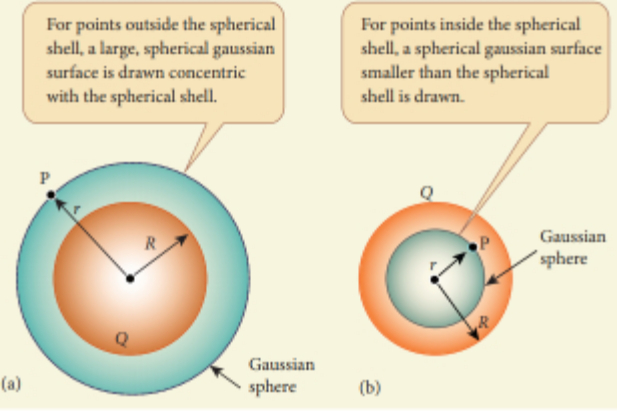
total charge enclosed by this Gaussian
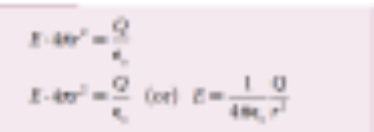
surface is Q. Applying Gauss law

The electric field
E and d A
point in
the same direction (outward normal) at
all the points on the Gaussian surface. The
magnitude of
E is also the same at all points
due to the spherical symmetry of the charge
distribution



Case (b): At a point on the surface of the
spherical shell (r = R)
The electrical field at points on the
spherical shell (r = R) is given b
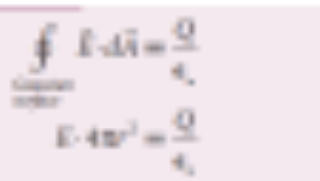

for a spherical shell of radius R
Since Gaussian surface encloses no
charge, Q = 0
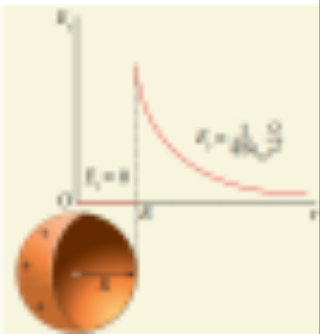
The electric field due to the uniformly
charged spherical shell is zero at all points
inside the shell.
A graph is plotted between the electric
field and radial distance
Gauss law is a powerful
technique whenever a given
charge configuration possesses
spherical, cylindrical or planar symmetry,
then the electric field due to such a charge
configuration can be easily found. If there
is no such symmetry, the direct method
(Coulomb’s law and calculus) can be used.
For example, it is difficult to use Gauss law to
find the electric field for a dipole since it has
no spherical, cylindrical or planar symmetry.
 rakupmaedcation. com